How Long Should You Hold a Plank? 30 Good Seconds Beat 5 Sloppy Minutes
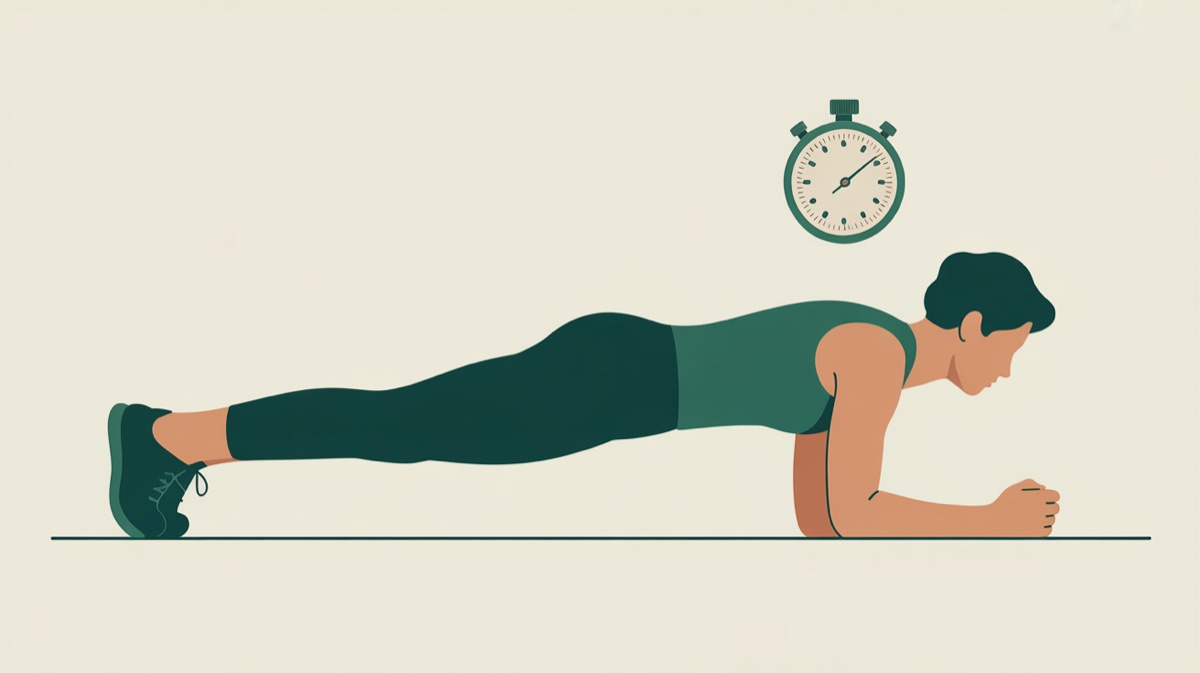
Hold a plank for 10–30 seconds at a time, rest briefly, and repeat for 3–5 sets. For building real core endurance, that beats a single long max-effort hold — and the spine research points the same way.
If you want one benchmark: 60 seconds continuous with strict form is solid. Most people who claim multi-minute planks are sagging through the back half of them.
Below: hold times by level, why short sets win, a 3×30 protocol you can run on the 30-second timer, and what to do once 60 seconds gets easy.
Plank sets are 30 seconds of work, 30 seconds of rest — exactly what this timer was built for.
Open 30 Second Timer →Plank hold times by level
These numbers assume strict form (checklist below). A sagging 90-second plank counts for less than a rigid 20-second one.
| Level | Hold time | Sets | Rest between sets |
|---|---|---|---|
| Beginner | 15–30 seconds | 3 | 30–60 seconds |
| Intermediate | 30 seconds | 3–5 | 30 seconds |
| Advanced | 45–60 seconds, or 20–30 with a harder variation | 3–4 | 30 seconds |
Sixty seconds continuous — strict, breathing normally, no collapse at the end — is a legitimate benchmark for good core endurance. Once you can do that, add difficulty rather than duration.
Why short holds beat one long one
Spine researcher Stuart McGill has spent decades measuring trunk endurance, and his training recommendations favor repeated short holds — around 10 seconds each — over sustained maximal efforts. His lab published normative endurance times for low-back stabilization exercises, and the programming built on that work is all short, crisp repeats.
The logic: your core muscles are endurance muscles, and endurance is built with quality reps, not grinding. In a long hold, fatigue accumulates, form degrades, and the final minute mostly trains your tolerance for discomfort.
Watch anyone plank past their limit: the hips sag, the lower back drifts into extension, and load shifts off the muscles and onto the lumbar spine. That is the exact position a plank is supposed to protect you from.
The 3×30 protocol
For most people past their first couple of weeks, 30 seconds is the sweet spot: long enough to be a real stimulus, short enough that form survives the whole set. The 30-second set is also the reason this site exists, so the programming is simple:
- Set the timer to 30 seconds. Plank until it rings.
- Rest 30 seconds — restart the timer, stay on the floor.
- Repeat for 3–5 rounds, 3–4 days a week.
Equal work and rest keeps the session moving and keeps every rep honest. If 30 seconds breaks your form, drop the holds to 15–20 seconds and keep the 30-second rests. If five rounds feel easy, do not add time — move to the progressions below.
Form checklist: what a good second looks like
A second only counts if all of these hold at once:
- Straight line from ears through shoulders, hips, knees, and ankles. No peaks, no valleys.
- Elbows under shoulders, forearms flat, hands unclenched or lightly clasped.
- Glutes and abs braced — squeeze like you are about to take a punch.
- Neutral neck — eyes on the floor slightly ahead of your hands.
- Normal breathing — if you are holding your breath, you are past your limit.
The moment your hips sag or pike, the set is over, regardless of what the clock says. Stop, rest, and start the next round clean.
Past 60 seconds: make it harder, not longer
Once 60 strict seconds is comfortable, extra time returns less and less. Add load or leverage instead, and drop back down to 10–30 second sets:
| Progression | What changes | Why it works |
|---|---|---|
| Long-lever plank | Elbows a few inches ahead of your shoulders | Small position change, big jump in torque on the core |
| Weighted plank | Plate on the upper back | More load at the same duration |
| RKC plank | Maximal whole-body squeeze: glutes, quads, lats, fists | Turns 10 seconds into a genuine max effort |
| Side plank | On one forearm, feet stacked, hips high | Trains the QL and obliques that front planks miss |
Side planks deserve a permanent slot, not just a cameo — the lateral core does most of the anti-collapse work when you walk, run, or carry anything one-handed. Same prescription: sets of 10–30 seconds, both sides.
The world record is not a training plan
The record for the longest plank is 9 hours, 38 minutes, 47 seconds, set by Josef Šálek of the Czech Republic in 2023. It broke Daniel Scali's 2021 mark of 9 hours, 30 minutes, 1 second.
File that under trivia. A record hold is a feat of pain tolerance, pacing, and tiny weight shifts — not core training. Nobody's spine is better off in hour nine. Your 3×30 with honest form does more for your back than chasing minutes ever will.
Frequently asked questions
Is a 2-minute plank good?
A genuinely strict 2-minute plank shows solid endurance — well past the 60-second benchmark. The catch is that most 2-minute planks are only strict for the first minute. If you can truly hold form that long, your time is better spent on harder variations — long-lever, weighted, or RKC planks in 10–30 second sets. Extra minutes in a position that is easy for you stop producing adaptation.
Should you do planks every day?
You can — planks are low-load and recover quickly — but you do not need to. Three or four sessions a week of 3–5 quality sets builds core endurance fine. Daily planking mostly helps with habit-building. If you do plank every day, keep the sets short and strict; accumulating sloppy volume daily is worse than doing crisp work every other day.
Why do I shake during a plank?
Shaking is fatigued motor units firing out of sync as the working muscles run down. It is normal near your limit and not dangerous by itself, but it is a signal that form breakdown is close. A slight tremor in the last few seconds of a set is fine; violent shaking with sagging hips means the set should already have ended.
What if I can't hold a plank for 15 seconds?
Shorten the lever. Plank from your knees, or with your hands elevated on a bench or countertop — same straight-line rules, less load. Accumulate 3–4 sets of 15–30 seconds there, and move to the floor once the easier version feels comfortable for 45 seconds. Most people bridge that gap within a few weeks of consistent practice.
Do planks burn belly fat?
No. Planks build isometric core endurance and spinal stability; they burn few calories, and no exercise removes fat from one specific spot. Fat loss comes from a sustained calorie deficit. Planks are still worth doing because a fatigue-resistant core carries over to lifting, running, and back health — but visible abs are a body-fat question, not a plank question.
Plank sets are 30 seconds of work, 30 seconds of rest — exactly what this timer was built for.
Open 30 Second Timer →